
Introduction
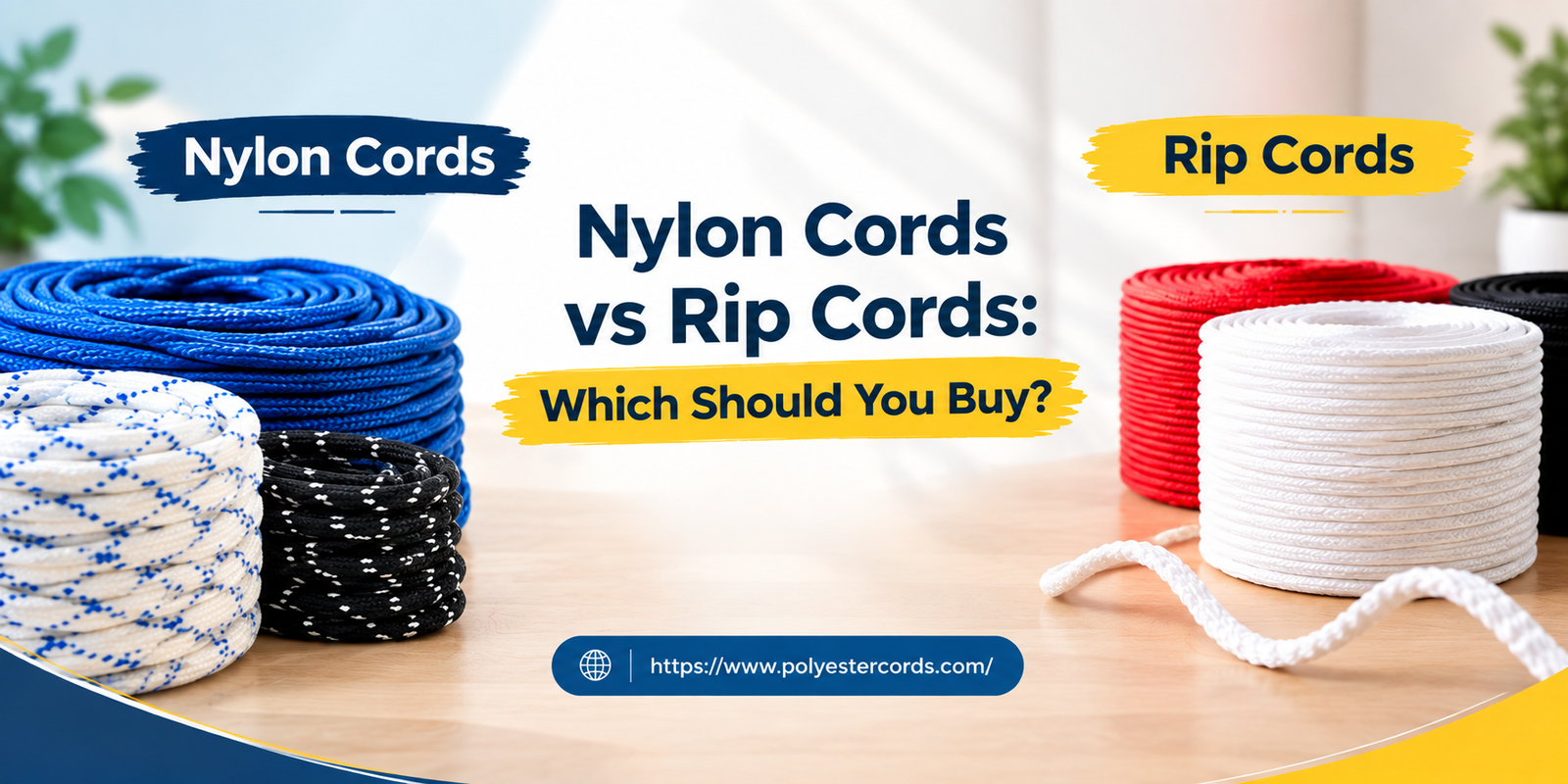
People sometimes talk about Nylon Cords and rip cords like they are two different materials. That is not right. Nylon is a material. A Rip Cords is a task.
A Rip Cords, and you may also hear it called a pull cord, is a cord meant to be yanked hard and quickly. Its job is to start, let go, or open something. Some rip cords are made from nylon. Others are made from polyester.
The key point is not the label. The key point is this. Will normal Nylon Cords handle the job, or do you need a cord made for pull and release? This guide is here to help you pick.
Quick Answer
| Nylon Cord (general purpose) | Rip Cord / Pull Cord | |
| What it is | A cord defined by its material | A cord defined by its use |
| Typical material | Nylon | Nylon or polyester, often braided |
| Main job | Drawstrings, lacing, binding, crafts, packaging | Pulling, starting, releasing, opening |
| Stretch | Moderate to high | Usually controlled for a firm pull |
| Abrasion resistance | Good | Must be high, as it runs through guides and handles |
| Best for | Everyday and decorative use | Repeated hard pulls |
| Buy when | You need a versatile, flexible cord. | The cord must survive sudden, repeated force |
Short version: a nylon cord works well. If the line will get sharp wear, you should switch to a rip or pull cord. Use that option when the cord will take hard, fast tugs and rub over edges or small guides.
Read More: Rip Cords | Shree Anand and Balaji Co.
What Is a Nylon Cords?
Nylon cords are made from nylon fibers. Those fibers are twisted or braided, then formed into a cord. It feels smooth and holds up under use
People choose nylon cord for a few clear reasons:
- It is tough without being too thick
- It bends easily and ties well
- It wears slower when it rubs
- It comes in many colors and sizes
You will spot it on drawstrings, shoelaces, bag handles, packing use, curtains, and crafts. It also shows up in small, light-duty jobs. Nylon stretches more than polyester, which can help with sudden force. At the same time, it can make it harder to keep a firm, tight hold.
Read More: Nylon Cords Supplier | Shree Anand and Balaji Co.
What Is a Rip Cord?
A Nylon Cords is a cord that you pull hard and fast to start or release something. You see them in a few common spots.
- Pull cord starters on lawn mowers, generators, and chainsaws
- Zipper pulls and quick-release cords on bags and outdoor gear
- Release cords on inflatables and safety setups
Since people yank the cord quickly, and it often slides through openings and guides, it should be
- Tough against wear, so it does not unravel at contact points
- Able to take a fast jolt, not only a slow, steady pull
- Made with steady thickness and braid, so it feeds without catching
- Simple to hold and tie, because a stopper knot or handle is often used
For life safety uses, like cords for parachute release, the materials are regulated. If you need this for that kind of use, get it only from a source that can provide test records.
Read More: Rip Cords Supplier | Shree Anand and Balaji Co.
Nylon vs Polyester: The Material Question
A rip cord can be made from different materials. That is why the choice between nylon and polyester is the real decision, not just the label on it.
| Property | Nylon | Polyester |
| Stretch | Higher, absorbs shock. | Lower, holds length |
| Abrasion resistance | Very good | Very good |
| UV resistance | Moderate, can fade or weaken over time | Better |
| Moisture | Absorbs water, can lose some strength when wet | Absorbs very little |
| Feel | Smooth, soft | Slightly firmer |
Pick Nylon Cords if you care about shock comfort and a softer touch. Pick polyester if the cord will be left outside in bright sun. Polyester can also help when you must keep a steady length. For many pull-start setups, nylon and polyester can both do the job. The better pick depends on the machine and the place it runs.
Read More: Nylon Cords Manufacturer | Shree Anand and Balaji Co.
Which Should You Buy? A Simple Checklist
Choose a general nylon cord if:
- You need drawstrings, laces, binding, or packaging cord
- The cord is pulled in a slow way, or you tie it off
- Color options and feel matter to you
- You want one cord that works for a few products
Choose a rip or pull cord if:
- The cord is yanked fast, like on an engine starter
- It slides over handles, pulleys, or guide parts
- You need the same thickness every time
- You want a firm pull with low stretch
- You are making OEM equipment for makers
Choose polyester over nylon if:
- The cord will stay outdoors with strong sun
- You want less stretch in use
- The cord will see water often
Read More: Rip Cords Manufacturer | Shree Anand and Balaji Co.
Five Questions to Answer Before You Order
1. Which cord is being pulled or let go, and how much force is needed?
2. What thickness should you choose? Most pull cords and drawstring cords fall around 2 mm to 6 mm. Pick a size that fits your handle, guide, or eyelet.
3. Will the cord be out in the sun, or near water? Will it touch oil or go near heat?
4. How is the end made? Look for heat-sealed ends, tied knots, end tips, or crimped fittings.
5. How many pieces do you need? Order a sample first, then request the larger quantity.
Things that go wrong when you do not plan ahead
- Do not use a soft decorative cord when you need a hard-pull cord. The soft type tends to fray or break sooner.
- Do not ignore stretch. If a cord stretches too much, the pull-start can feel weak.
- Do not skip a sample. Try a fit first, check how it feels, and look at the finish before you place a bulk order.
- Do not buy only by cost per kg. A lower-priced cord that fails can lead to more returns and wasted time.
Read More: Nylon Cords Supplier | Shree Anand and Balaji Co.
Final Thoughts: Nylon Cords or Rip Cords?
Nylon cords and Rip Cords are usually not direct rivals. Nylon is just the material. A Rip Cords is a cord made for a specific task, and that task is being yanked hard, quickly, and again and again. So the best question before you buy is not, “Which is better?” It is, “What will you ask this cord to do?”
If you need something to tie, lace, bind, or keep a drawstring shut, then simple Nylon Cords are often enough. It feels smooth, it bends easily, and it ties in normal knots without much trouble. You can also find it in many colors and sizes. If the cord will spend time outside, or it will get wet often, polyester can be the better match than nylon.
No matter which you pick, three habits help you avoid expensive errors. Use the right diameter for your handle or eyelet. Think about the stretch and the weather before choosing a material. Also, test a small piece before you order a large lot. A cord can look fine on paper but act differently once it is in your product, and a short trial is cheaper than sending back a full order.
Read More: Nylon Cords | Shree Anand and Balaji Co.
FAQs
1. Is a rip cord the same as a nylon cord?
No. Nylon Cords are the material. A rip cord is a cord made for pulling. Many rip cords are made from nylon.
2. Can I use nylon cord as a pull-start cord?
Maybe. You can use it only if the size, braid, and strength match your engine. First, check what the equipment maker says. Or use our pull start cord size guide.
3. Which lasts longer, nylon or polyester?
It depends on where and how you use it. Polyester usually does better in sun and wet areas. Nylon often deals well with sudden shock loads. Try a small test piece in your actual use.
4. What rip cord size should I buy?
Use the sizes that match the handle, the guide, and the starter housing. Measure your old cord. Or check the equipment manual.
5. Do you offer custom colors and lengths?
Yes. Please confirm your options. Tell us your specs, and we will help.
